
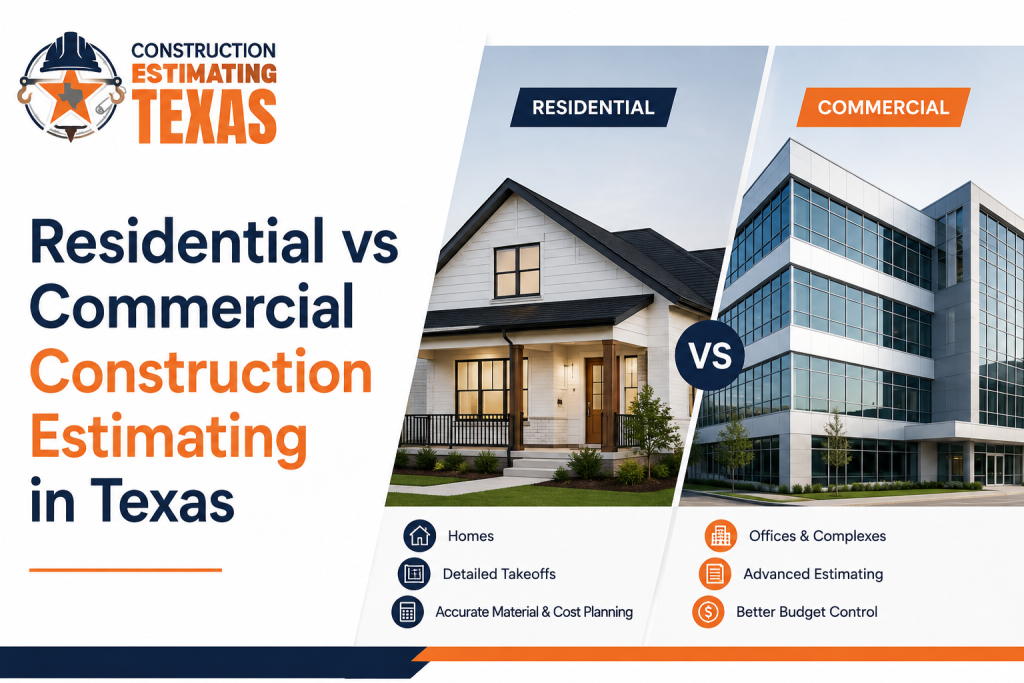
Not all construction projects are estimated the same way. A custom home and a large commercial building may both require accurate cost calculations, but the estimating process behind them is very different. In Texas’s fast-growing construction market, contractors rely on precise estimates to control costs, avoid delays, and stay competitive. That is why many builders use Texas construction estimating services to prepare reliable estimates and bid with confidence.
What You’ll Learn
Residential and commercial projects come with different budgets, materials, labor requirements, and regulations. This guide explores the major differences between residential and commercial construction estimating and shares practical tips to help contractors prepare more accurate and profitable bids.
Why Construction Estimating Matters in Texas
Texas has one of the fastest-growing construction markets in the United States. New housing developments, office buildings, schools, hospitals, warehouses, and industrial facilities are being built across the state every year. With this growth comes increased competition among contractors.
Clients expect detailed estimates that accurately reflect project costs, while contractors must deal with fluctuating material prices, labor shortages, and changing building regulations. Many contractors use Texas construction estimating services to ensure every estimate is based on current pricing, detailed quantity takeoffs, and local market conditions. A reliable estimate helps contractors:
- Prepare competitive bids
- Plan project budgets
- Purchase the right amount of materials
- Reduce financial risks
- Avoid unexpected project costs
What Is Residential Construction Estimating?
Residential construction estimating is the process of calculating the total cost of building or renovating a home. The estimate includes everything needed to complete the project, from site preparation to the final finishes. Residential estimates are usually prepared for homeowners, builders, or residential developers. Since homeowners often work within fixed budgets, estimating accuracy is extremely important. Common residential projects include:
- Single-family homes
- Duplexes
- Townhouses
- Home additions
- Kitchen and bathroom remodeling
- Custom homes
What Does a Residential Estimate Include?
A residential construction estimate includes all the costs required to complete a project from start to finish. It helps contractors and homeowners understand the expected budget before construction begins.
- Material quantities
- Labor costs
- Equipment rentals
- Site preparation
- Foundation work
- Framing materials
- Roofing
- Plumbing
- Electrical work
- HVAC installation
- Interior and exterior finishes
- Permit fees
- Contractor overhead and profit
Challenges of Residential Construction Estimating
Although residential projects are generally smaller than commercial projects, they still present several estimating challenges.
Frequent Design Changes
Homeowners often request changes during the planning stage. Even small changes can affect material quantities, labor hours, and the overall budget.
Material Price Changes
Residential projects rely on materials such as lumber, drywall, roofing products, flooring, and insulation. Price changes in any of these materials can significantly affect the estimate.
Tight Budgets
Most homeowners have fixed budgets. Contractors must prepare estimates that balance quality with affordability while still maintaining healthy profit margins.
Scheduling Multiple Trades
Residential projects involve several subcontractors working together, including electricians, plumbers, painters, HVAC technicians, and flooring installers. Delays in one trade can affect the entire schedule.
What Is Commercial Construction Estimating?
Commercial construction estimating involves calculating the cost of larger and more complex construction projects. These projects often require multiple contractors, specialized equipment, and detailed coordination between different trades. Because these projects are larger, commercial estimates require more detailed planning and documentation than residential estimates. Commercial construction projects include:
- Office buildings
- Shopping centers
- Schools
- Hospitals
- Hotels
- Warehouses
- Manufacturing facilities
- Government buildings
What Does a Commercial Estimate Include?
Commercial estimates cover a much wider range of costs. Commercial estimates also include detailed labor calculations, equipment expenses, indirect costs, and contingency allowances. They usually include:
- Structural concrete
- Structural steel
- Masonry
- Roofing systems
- HVAC systems
- Plumbing systems
- Electrical systems
- Fire protection systems
- Site development
- Earthwork
- Heavy equipment
- Building permits
- Safety requirements
- Temporary facilities
- Project management costs
- Specialized subcontractor
Challenges of Commercial Construction Estimating
Commercial projects present unique estimating challenges that require careful planning.
Large Project Scope
Commercial buildings contain thousands of materials and many different construction activities. Missing even a small item during the estimating process can result in significant financial losses.
Complex Building Systems
Commercial buildings include advanced HVAC, electrical, plumbing, fire protection, and communication systems that require specialized estimating knowledge.
Strict Building Regulations
Commercial projects must comply with detailed building codes, safety standards, accessibility requirements, and environmental regulations.
Multiple Stakeholders
Commercial construction often involves architects, engineers, owners, consultants, subcontractors, and project managers. Estimators must coordinate information from several sources to prepare an accurate bid.
Higher Financial Risk
Commercial projects involve much larger budgets. Even a small estimating error can cost thousands of dollars.
Which Type of Estimating Demands More Precision?
Both residential and commercial estimating have their own challenges. Residential estimating requires contractors to work within tight budgets while managing frequent client requests and design revisions. Small mistakes can quickly reduce profits because residential projects usually have lower margins.
Residential Construction
Residential construction projects typically involve:
- Smaller project sizes
- Lower construction budgets
- Simpler building systems
- Fewer subcontractors
- More flexibility for design changes
- Shorter construction schedules
- Simpler permit requirements
- Lower financial risk
Commercial Construction
Commercial construction projects generally include:
- Large and complex project scopes
- Higher project investments
- Advanced MEP (Mechanical, Electrical, and Plumbing) systems
- Multiple specialized trades and subcontractors
- Detailed project specifications
- Longer construction timelines
- Strict building codes and regulatory compliance
- Higher financial risk
Commercial estimating is generally more demanding because projects are larger and involve many specialized systems. Contractors must coordinate multiple subcontractors, comply with complex regulations, and prepare highly detailed estimates.
The Smart Way to Prepare More Competitive Bids
Preparing accurate estimates requires time, experience, and access to updated pricing information. As workloads increase, many contractors choose to outsource part or all of their estimating work. It helps contractors prepare reliable estimates while reducing the pressure on internal teams. Outsourcing estimating also allows contractors to bid on more projects without sacrificing quality or accuracy. Some of the main benefits include:
- Accurate quantity takeoffs
- Current Texas labor and material pricing
- Faster turnaround times
- Reduced estimating workload
- More competitive bids
- Better project budgeting
- More time to manage ongoing projects
Best Practices for Accurate Construction Estimates
Accurate estimating requires more than experience. A consistent process helps contractors avoid costly mistakes and prepare reliable bids for both residential and commercial projects. Following these steps helps contractors reduce financial risks and improve overall project profitability.
- Review the latest construction drawings before estimating.
- Verify all material quantities with a detailed takeoff.
- Use updated labor and material prices for Texas.
- Include indirect costs such as permits, equipment, and site expenses.
- Allow for material waste and contingency costs.
- Confirm supplier and subcontractor quotations.
- Double-check calculations before submitting the final bid.
- Consider using estimating services during busy bidding periods to improve accuracy and save time.
Why Contractors in Texas Outsource Their Projects in Return for What They Get
Many contractors outsource their estimates to save time and improve accuracy. Preparing detailed estimates takes hours of work, especially when managing multiple projects. Professional estimators help contractors submit bids faster without affecting quality.
Outsourcing also reduces costly estimating mistakes and provides access to current material and labor pricing. It allows contractors to bid on more projects, control overhead costs, and spend more time managing construction instead of preparing estimates.
Conclusion
Residential and commercial construction estimating follow different processes, but both require accurate planning to keep projects on budget and profitable. Residential projects are generally simpler, while commercial projects involve larger budgets and greater complexity. By following a structured estimating process and partnering with Construction Estimating Texas for professional estimating services, contractors can improve bid accuracy, reduce costly risks, and stay competitive in Texas’s growing construction industry.
Frequently Asked Questions
Why is commercial construction estimating more complicated?
Commercial projects involve larger budgets, multiple subcontractors, advanced MEP systems, strict building codes, and longer construction schedules, making the estimating process more detailed.
What should be included in a residential construction estimate?
A residential estimate should include material quantities, labor costs, equipment, permits, site preparation, subcontractor costs, contractor overhead, and profit.
How does accurate estimating improve project success?
Accurate estimates help contractors control costs, avoid budget overruns, reduce delays, improve client satisfaction, and increase the chances of completing projects profitably.
